
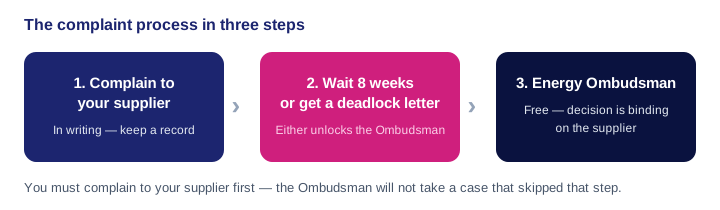
Step 1: complain to your supplier first
The Ombudsman won't look at your case until you've given your supplier a fair chance to fix it — so the supplier's own complaints process is always the first step. You can usually find it on their website, and you can complain by phone, email or post.
- Complain in writing if you can — email or letter gives you a dated record. If you phone, note the date, time, who you spoke to, and what was said.
- Say clearly what went wrong, what you want them to do about it, and by when. Vague complaints get vague answers.
- Include your account number and attach evidence: bills, meter readings, photos of a faulty meter, or copies of earlier messages.
- Ask for a reference number and a written response, and keep copies of everything you send.
- Ask specifically for compensation if the problem caused you real hassle or cost — for example, repeated failed appointments or a billing error that took months to fix.
What a strong complaint includes
- A short timeline: when the problem started, what happened, and what you've already tried.
- The outcome you want: a corrected bill, a refund, a tariff change, an apology — be specific.
- The impact: time spent, money lost, or stress caused. This matters for compensation.
- A deadline: give them a reasonable date to respond, and note that you will escalate if they don't.
If you need help drafting it, the Citizens Advice consumer helpline can support you, and it has a template complaint letter you can use.
Step 2: escalate after 8 weeks — or with a deadlock letter
Your supplier has 8 weeks to resolve your complaint. If 8 weeks pass without a satisfactory resolution, you can escalate to the Energy Ombudsman. You can also escalate immediately if your supplier sends you a deadlock letter — a final response saying you and the supplier can't agree. Either route unlocks the Ombudsman.
- Don't wait silently: if weeks pass with no progress, chase the complaint in writing and note the dates.
- Keep the deadlock letter safe — it starts the clock for escalating.
- You generally have 12 months from the deadlock letter to take the case to the Ombudsman, so don't leave it until the last minute.
Step 3: the Energy Ombudsman
The Energy Ombudsman is an independent, Ofgem-approved service that resolves disputes between domestic customers and energy suppliers. It's free, and it handles complaints about billing, switching problems, customer service, installations, sales practices and supply problems. It can't rule on the prices suppliers set.
- Register your dispute online at the Energy Ombudsman website, or by phone on 0330 440 1624, email at enquiry@energyombudsman.org, or post to Energy Ombudsman, PO Box 966, Warrington WA4 9DF.
- Send your evidence: the complaint timeline, bills, letters, and the deadlock letter if you have one.
- The Ombudsman investigates both sides and issues a decision — typically within around six weeks. It can order an apology, practical action (such as correcting a bill or changing a tariff), or compensation.
- If you accept the decision, it is binding on the supplier. If you reject it, you can still take the matter elsewhere, but you can't then enforce that decision.
- Every energy supplier for domestic customers must belong to the scheme, so your supplier is covered.
Common complaints that win
- Estimated bills that ignore your readings and keep coming back wrong.
- Switches that went wrong — wrong tariff, wrong start date, or a switch you never agreed to.
- Direct debits hiked without explanation, or credit balances not refunded.
- Prepayment meters fitted without proper process, or top-up problems.
- Long waits, lost complaints, or promises that were never kept.
If any of these sound familiar, check the related guides — a billing error is often easier to fix once you can read your energy bill properly. And add your energy bill to UK Bill Tracker — free — so renewal dates and price changes never catch you out again.
Track your energy bill freeFrequently asked questions
When can I go to the Energy Ombudsman?
Once 8 weeks have passed since your complaint without a resolution, or immediately if your supplier sends you a deadlock letter.
Is the Energy Ombudsman free?
Yes — the service is free for domestic customers, and its decisions are binding on the supplier if you accept them.